Making Science Visible
Award winning photograph by researcher Ivar Noordstra (Radboudumc) has attracted national attention. [ad.nl] and [Dit microscoopfotootje van 0,3 millimeter kan de sleutel zijn tot het herstellen van blindheid | Regio | De Gelderlander.nl]
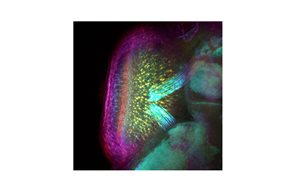
The image, only 0.3 millimeters in size, shows the development of an eye in a zebrafish embryo and could provide important insights for future restoration of vision.
The photo was awarded the Envision Award 2026, a prize for the most striking scientific image within Radboudumc.
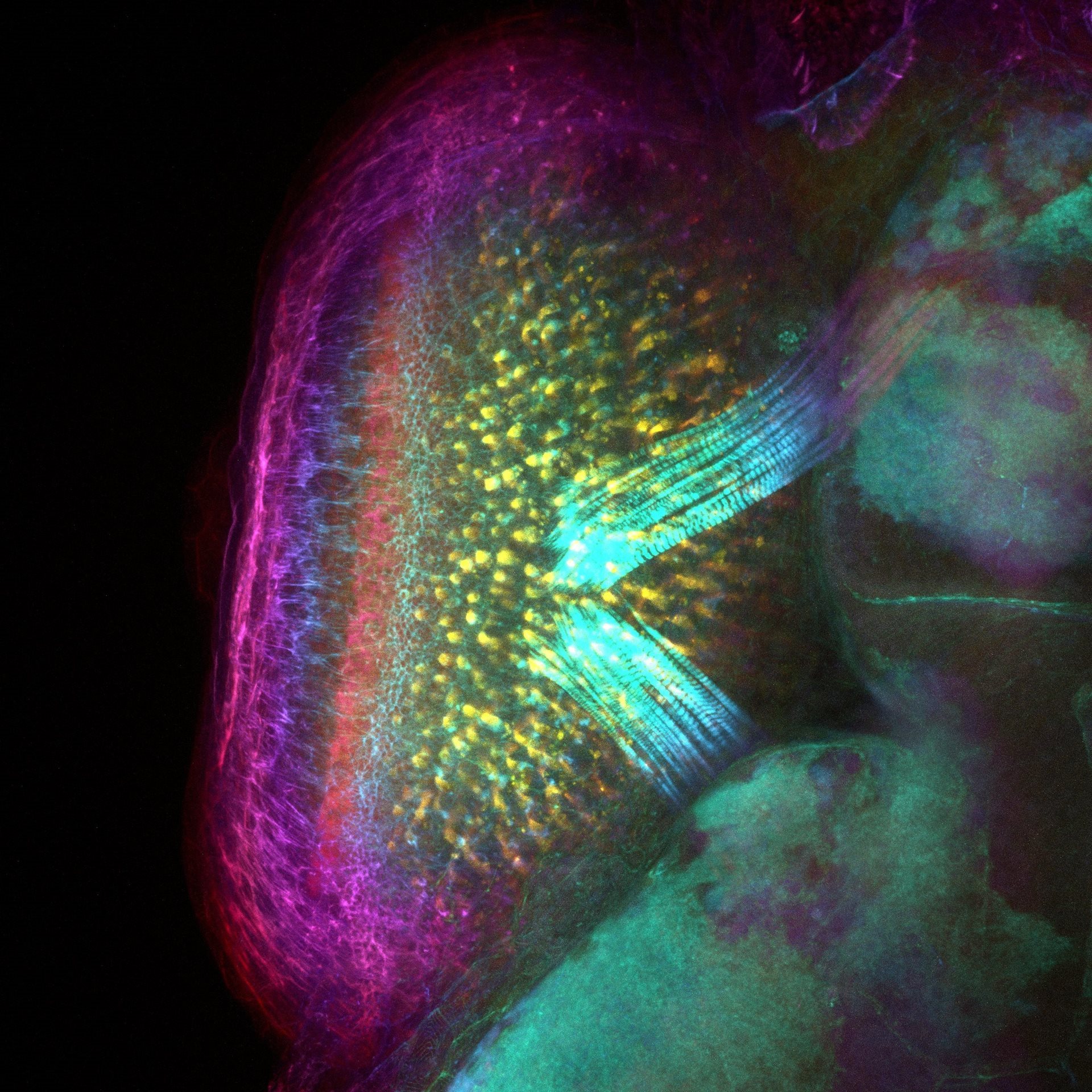
Behind the photo lies important research: zebrafish are able to repair a damaged retina themselves, whereas this is not possible in humans. By studying this mechanism, researchers hope to find clues to enable retinal repair in people as well.
From Zebrafish to Humans
What the image shows is the developing eye of a zebrafish, including the different layers that make up the retina. Notably, zebrafish are able to repair damage to their retina on their own—something that is not possible in humans.
Noordstra’s research investigates the mechanisms behind this regenerative ability. In zebrafish, stem cells are activated to form new retinal cells, whereas similar stem cells in humans remain inactive.
A Long-Term Goal: Restoring Vision
By understanding how this process works in zebrafish, researchers hope to find ways to enable retinal repair in humans as well. This could represent a breakthrough for patients with severe eye diseases, such as Usher syndrome, in which people eventually lose their vision.
This research, part of the Lifelong Vision consortium, contributes to the development of new treatment options for blindness — with the ultimate goal of restoring vision.
Related news items
PI Progress Meeting and Scientific Advisory Board Visit
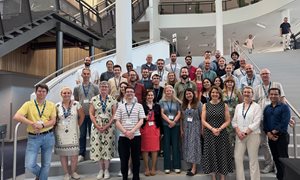
16 July 2026We were delighted to welcome Kapil Bharti and Anneke den Hollander to the Netherlands for our PI Progress Meeting. This provided a valuable opportunity for scientific exchange, strategic reflection, and interaction with consortium members.
go to pageFirst Summer School Brings Together Young Researchers for Two Inspiring Days
7 July 2026On Thursday 25 and Friday 26 June, we successfully hosted our first Summer School. Despite taking place during the hottest days of June, the enthusiasm and engagement of all participants made it a great success!
go to page
2nd Lifelong VISION Amsterdam seminar
28 May 2026On the 16th of April, the 2nd Lifelong Vision Amsterdam seminar brought our community together in a brisk afternoon of curiosity and collaboration.
go to page
Sensathon 2026 - Searching for answers together
13 April 2026On April 10th, Susanne Roosing, Rob Collin and Sterre Mulder of the LifeLong Vision consortium organized with Mechteld van Olden and Dirk Wijn the Sensathon, during the Hearing & Vision 4 All research program day at Radboudumc.
go to page
Breakthrough in Research on Inherited Blindness!
12 January 2026Researchers at Radboudumc have discovered a new genetic cause of retinitis pigmentosa (RP) — an eye disease affecting about 1 in 5,000 people worldwide, often leading to tunnel vision and eventually complete blindness.
go to pageZohreh Hosseinzadeh at BMPN Annual meeting
24 November 2025At the BMPN Annual meeting Zohreh Hosseinzadeh presented Lifelong Vision as an example of promoting collaboration between clinical practice and scientific research.
go to page